

Why it matters
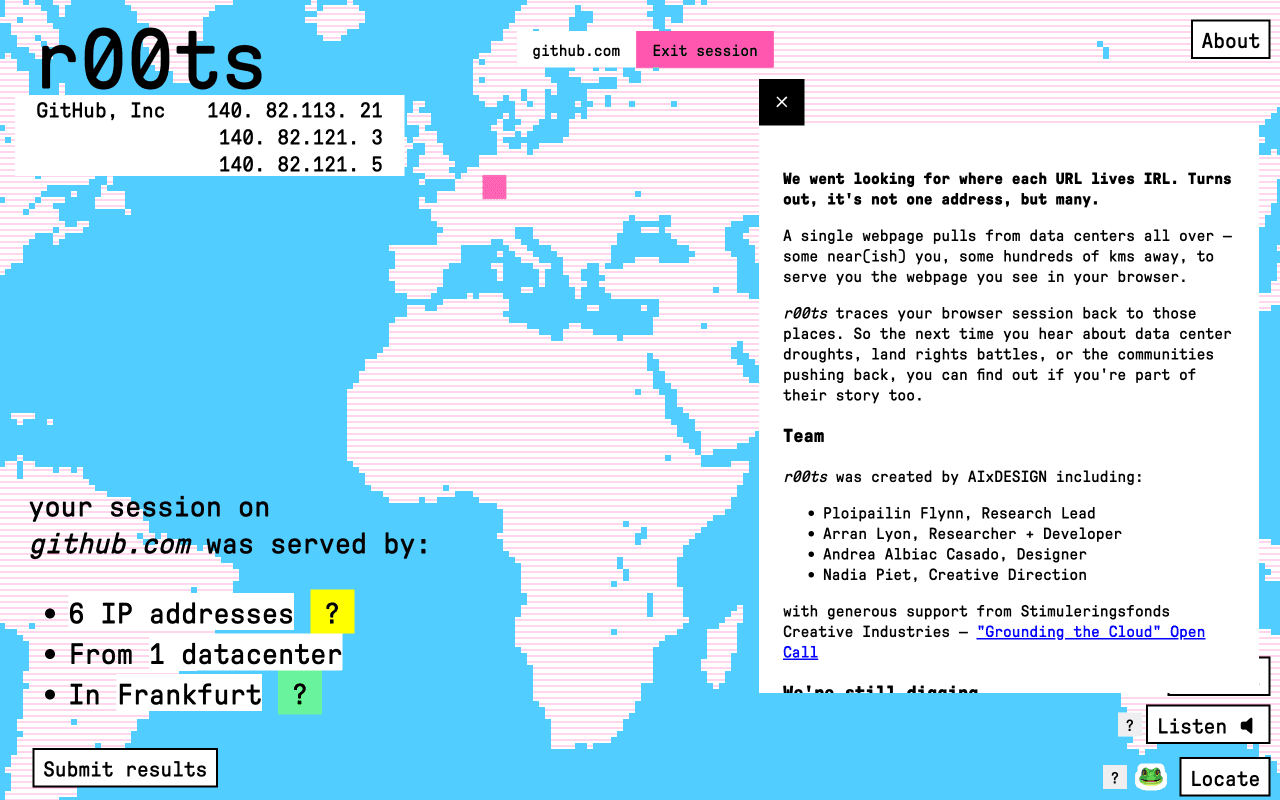
The internet isn't in the cloud. It lives at an address.
Every video you stream, feed you scroll, website you visit comes from a place, a building, a data center. It has an address. It sits on someone's land, draws power from a specific grid, and pulls water from local reservoirs, with real people living right next to it. This isn't a secret. Researchers and journalists are documenting it medium-well. But that documentation sits conceptually far from how we use the internet every day. r00ts brings those investigations closer, rooting your everyday browsing to the data center that powers it.
How we did it

We started with this question: can we find where each URL lives IRL? In short, sort of.
Stimuleringsfonds Creatieve Industrie generously backed us with a €30,000 grant, through Grounding the Cloud, to find out. We came in with a pile of ideas: things we wanted to learn, interactions we wanted to build. But a finite budget forces focus, so we kept the design and build small, sweet, do-able. We hope r00ts is just the start to this work, not a pixel-perfect end.
Along the way, we documented what we were trying to learn, what we tried, and what we decided, dead-ends and wish-list builds included.
Dig into the Project Vault
What we made
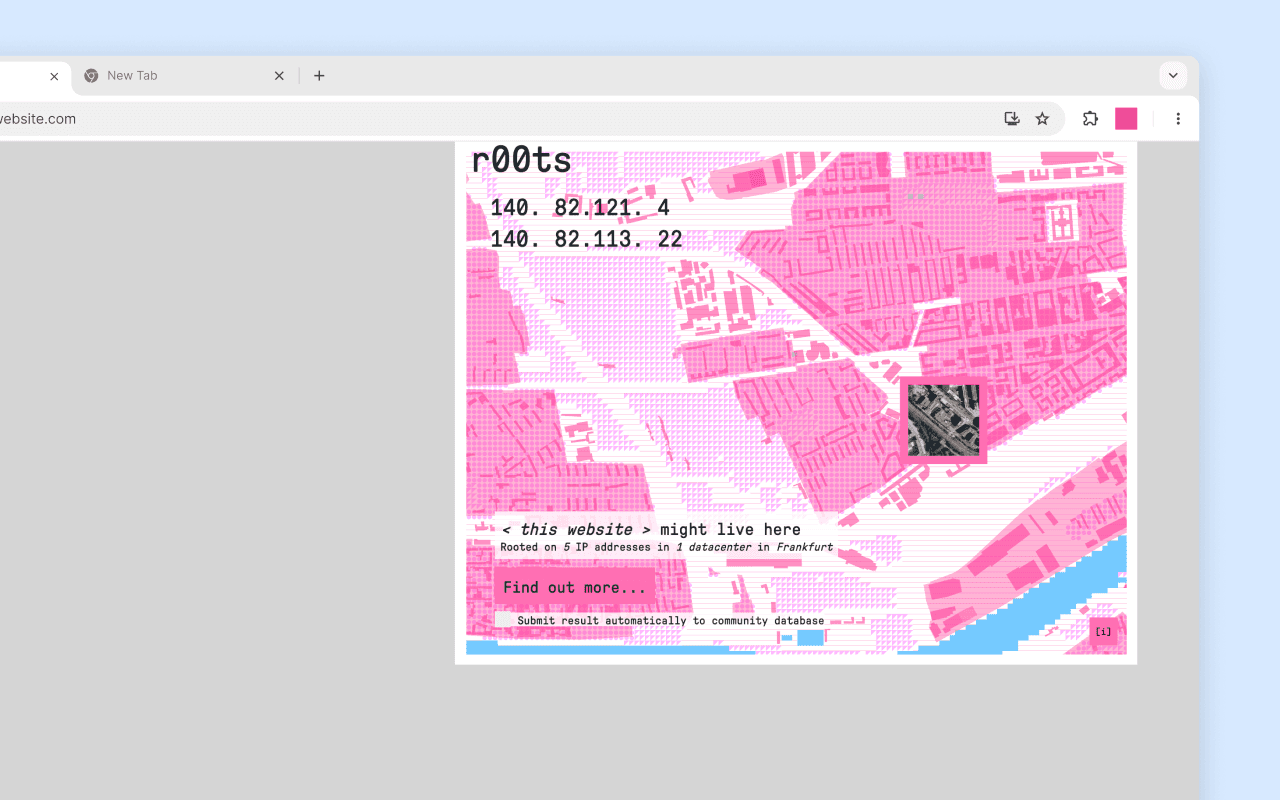
Start here. r00ts is a free, open-source extension for Chrome and Firefox that traces the page you're on to the data centers likely serving it. Open any site, click the r00ts icon, and it follows that page's requests to their IP addresses, then to the networks and facilities behind them. For each one, we show our work, the clues we followed to land on that specific building, so you can run the same kind of investigation yourself. Some sit near(ish) you; some are a world away. It collects nothing about you: no accounts, no cookies, no logs. It's not in the Chrome or Firefox stores yet, so for now it's a manual install.


r00ts.xyz is where the results live: a world map of data centers, and a search of everything other people have already traced. Nothing to install. Look up a site and you'll see the data centers users have found for it, combined across everyone who traced it. Tracing your own browsing happens in the extension, and every result someone chooses to share joins the map here, so it's built by use rather than scraped. Each entry records the website and its data centers, never who looked.


Everything we found lives on a public Miro board: notes, sources, loose threads, dead ends and all. Have a poke around, add what you know, tell us what we missed.




More projects.
(2019-25©)

