

Why it matters
Big Tech’s data machine treats culture as raw material, hoovering up whatever's easiest to scrape: the loudest, most documented, most Western, most profitable.
It scrapes and standardizes it, stripping away the fuzzy human bits that don’t fit into precise, homogeneous categories. Minority and diaspora cultures often don’t make the cut.
The result? AI tools that flatten out cultural nuance and authenticity into algorithmic mush, erasing traditions in favor of scale and profit.
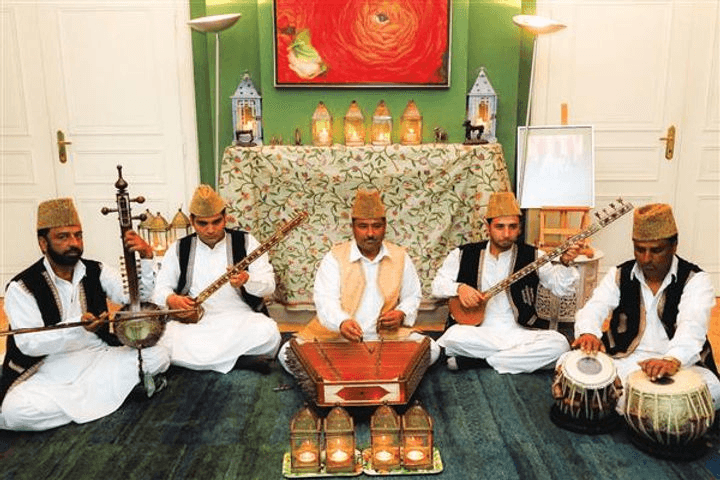
This much is true for the Kashmiri Pandit community, whose folk music is vanishing: confined to degrading cassette tapes with no institutional archiving, disappearing as older musicians pass away.
Saz-e-yaad slows down and zooms in to address the urgent need of preserving this vulnerable and rich cultural heritage. Working directly with the Kashmiri Pandit community to label and archive their music on their own terms, we’re showing that another kind of dataset is possible: one that honors the people it comes from, rather than extracting from them.
How we did it

We started with the music, and let the community tell us what it meant.
Through an Open Culture Tech residency, funded by Cultuurloket DigitALL, musician Lacuna (Mihir Raina) and ML researcher Moisés Horta Valenzuela (hexorcismos) worked with Kashmiri folk music producers Ravimech Studios and Uteesh Dhar to collate an archive of 1,000+ tracks, 400+ hours of music, from the Hindu minority Kashmiri Pandit community.
Building on our Slow AI research, we took a community-first approach: labeling the archive in ways that encode what these tracks mean to the diaspora, not just what they are, what we call "fuzzy" data. Mihir curated separate track selections for four models, Moisés trained them, and on 30 May Lacuna brought the results on stage at De Helling, Utrecht.
What we made
A desktop tool that wraps four generative models, trained on the Kashmiri folk archive, behind a single interface.
Pick a model, steer it with an audio or text prompt, and it generates new music in the style of the archive, ready to drag into Ableton or any DAW. Built by Moisés Horta Valenzuela (hexorcismos) with Lacuna (Mihir Raina) during an Open Culture Tech residency.

On 30 May, Lacuna took Saz-e-yaad on stage at De Helling, Utrecht,
weaving generated textures into a live set built from the same Kashmiri archive. One visitor said it felt both traditional and experimental



More projects.
(2019-25©)

